

Viscosity is a crucial physical property that significantly influences the performance and application of various substances, including liquid soil stabilizers. As a supplier of liquid soil stabilizers, understanding the viscosity of these products is essential for both product development and customer satisfaction. This blog post will delve into what viscosity is, its importance in liquid soil stabilizers, factors affecting viscosity, and how it impacts the practical use of our Liquid Soil Stabilizer products.
What is Viscosity?
Viscosity refers to a fluid's resistance to flow. In simpler terms, it measures how thick or thin a liquid is and how easily it can be poured or spread. For example, honey has a high viscosity because it flows slowly, while water has a low viscosity and flows freely. In scientific terms, viscosity is the internal friction of a fluid, arising from the interaction between its molecules as they move past one another. There are two main types of viscosity: dynamic viscosity and kinematic viscosity. Dynamic viscosity, often denoted by the Greek letter μ (mu), is the measure of the fluid's resistance to deformation under shear stress. It is expressed in units of pascal - seconds (Pa·s) or poise (P), where 1 Pa·s = 10 P. Kinematic viscosity, denoted by the Greek letter ν (nu), takes into account the fluid's density and is defined as the ratio of dynamic viscosity to density. It is measured in square meters per second (m²/s) or stokes (St), with 1 m²/s = 10⁴ St.
Importance of Viscosity in Liquid Soil Stabilizers
The viscosity of a liquid soil stabilizer plays a vital role in its effectiveness and application. Here are some key aspects where viscosity matters:
- Mixing and Dispersion: A liquid soil stabilizer needs to be thoroughly mixed with the soil to achieve uniform stabilization. If the viscosity is too high, it may be difficult to mix the stabilizer evenly with the soil, leading to uneven distribution and potentially reduced stabilization效果. On the other hand, if the viscosity is too low, the stabilizer may flow too quickly through the soil pores, resulting in poor retention and limited interaction with soil particles.
- Penetration: For effective soil stabilization, the liquid stabilizer must penetrate into the soil matrix. The viscosity of the stabilizer affects its ability to penetrate the soil. A lower - viscosity stabilizer can penetrate more easily into the soil pores, reaching deeper layers and providing better stabilization. However, if the viscosity is extremely low, the stabilizer may not stay in the soil long enough to react effectively.
- Workability: In construction projects, the workability of the liquid soil stabilizer is crucial. A stabilizer with an appropriate viscosity is easier to handle, transport, and apply. It can be pumped, sprayed, or spread using standard construction equipment without causing excessive clogging or splashing.
Factors Affecting the Viscosity of Liquid Soil Stabilizers
Several factors can influence the viscosity of liquid soil stabilizers:
- Chemical Composition: The type and concentration of chemicals in the stabilizer formulation have a significant impact on viscosity. For example, polymers are commonly used in liquid soil stabilizers, and different polymers have different viscosities. Higher polymer concentrations generally result in higher viscosities. Additionally, the presence of additives such as surfactants, solvents, and cross - linking agents can also affect the viscosity of the stabilizer.
- Temperature: Temperature has a profound effect on the viscosity of liquids. In general, as the temperature increases, the viscosity of a liquid soil stabilizer decreases. This is because higher temperatures provide more energy to the molecules, allowing them to move more freely and reducing the internal friction. Conversely, at lower temperatures, the viscosity increases, making the stabilizer thicker and more difficult to handle.
- Shear Rate: The shear rate, which is the rate at which a fluid is deformed, can also affect its viscosity. Some liquid soil stabilizers exhibit non - Newtonian behavior, meaning their viscosity changes with the shear rate. For example, a shear - thinning fluid has a lower viscosity at higher shear rates, which is beneficial for applications such as pumping and spraying, where high shear rates are involved.
Impact of Viscosity on Practical Use
The viscosity of our liquid soil stabilizers has a direct impact on their practical use in various construction and soil - related projects:
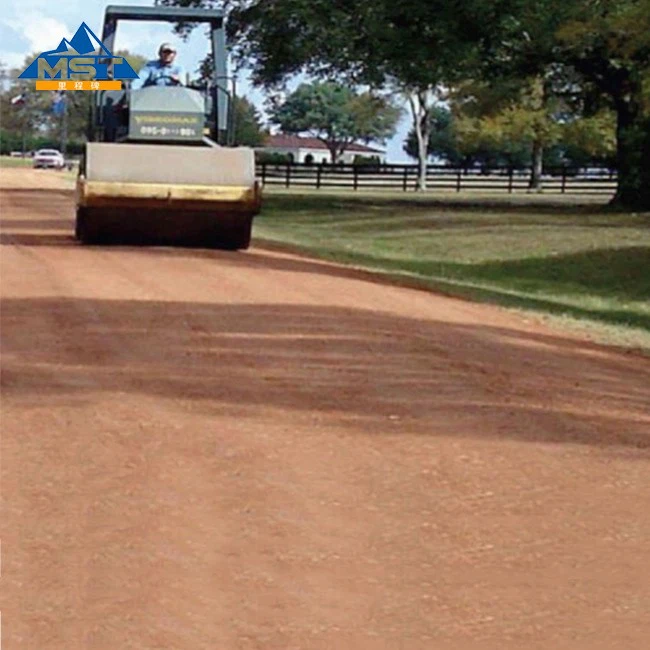
- Road Construction: In road construction, Subgrade Stabilizer is often used to improve the strength and stability of the road subgrade. A stabilizer with the right viscosity can be easily mixed with the subgrade soil and penetrate to an appropriate depth, enhancing the load - bearing capacity of the road. If the viscosity is too high, it may be difficult to achieve a homogeneous mixture, leading to weak spots in the subgrade.
- Erosion Control: For erosion control applications, such as slope stabilization, a liquid soil stabilizer needs to adhere to the soil surface and form a protective layer. A stabilizer with a suitable viscosity can spread evenly over the soil and provide long - lasting protection. If the viscosity is too low, the stabilizer may wash away easily during rainfall, while a very high - viscosity stabilizer may not spread well and leave gaps in the protective layer.
- Landscaping and Agriculture: In landscaping and agriculture, Acrylic Soil Stabilizer can be used to improve soil structure and prevent soil erosion. The viscosity of the stabilizer affects its ability to be applied to large areas efficiently. A stabilizer with an appropriate viscosity can be sprayed evenly over the soil surface, ensuring good coverage and effective stabilization.
Measuring and Controlling Viscosity
As a supplier of liquid soil stabilizers, we use advanced techniques to measure and control the viscosity of our products. Viscosity can be measured using viscometers, which come in different types, such as rotational viscometers and capillary viscometers. Rotational viscometers are commonly used in our quality control processes as they can measure the viscosity under different shear rates. To control the viscosity of our stabilizers, we carefully adjust the chemical composition during the manufacturing process. We also monitor and control the temperature during production, storage, and transportation to ensure that the viscosity remains within the desired range.
Conclusion
In conclusion, the viscosity of liquid soil stabilizers is a critical property that affects their performance, application, and workability. As a supplier, we understand the importance of viscosity and take every measure to ensure that our Liquid Soil Stabilizer products have the optimal viscosity for different applications. Whether you are working on road construction, erosion control, or landscaping projects, choosing a liquid soil stabilizer with the right viscosity can significantly improve the effectiveness of your project. If you are interested in our liquid soil stabilizer products or want to discuss your specific requirements, we invite you to contact us for procurement and further negotiation. We are committed to providing high - quality products and professional technical support to meet your soil stabilization needs.

References
- Bird, R. B., Stewart, W. E., & Lightfoot, E. N. (2007). Transport Phenomena (2nd ed.). Wiley.
- ASTM International. (2019). Standard Test Methods for Viscosity of Adhesives. ASTM D2196 - 19.
- Holtz, R. D., & Kovacs, W. D. (1981). An Introduction to Geotechnical Engineering. Prentice - Hall.